
Did recklessness, panic, and a lack of humanity cost innocent people their lives?
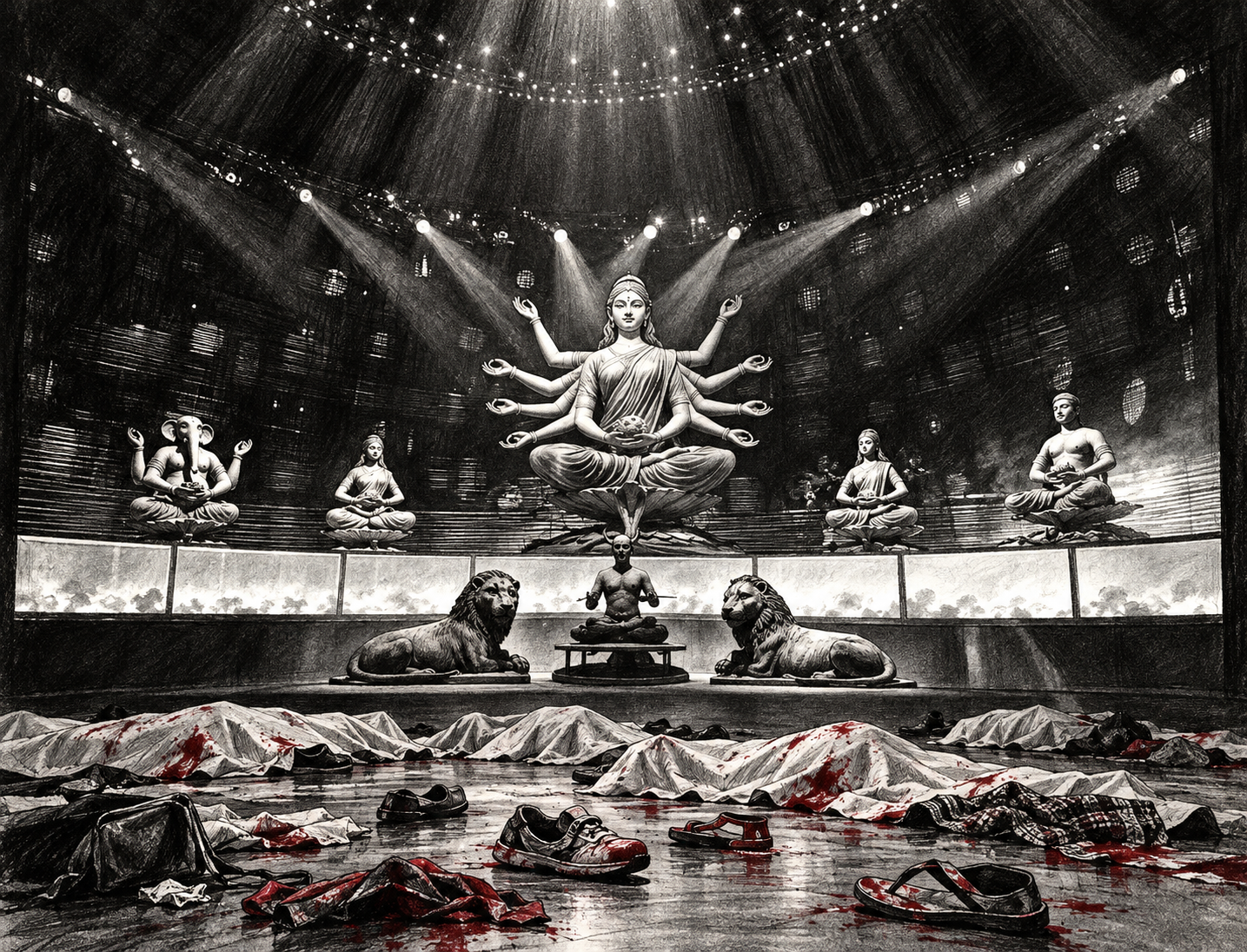
Kolkata, October 18: Amid the festive spirit of Durga Puja, tragedy struck at the Chorbagan Sarbojanin Durga Puja pandal in North Kolkata. On Saturday evening, October 17, a stampede-like situation reportedly claimed at least 17 lives, according to preliminary news reports, while several others were injured. The injured were taken to Calcutta Medical College and Hospital. The incident reportedly occurred at around 7:40 PM amid heavy rainfall and a massive gathering of visitors.
But beyond the immediate tragedy, one question deserves serious reflection: Whenever a disaster occurs, do we simply blame the administration, the authorities, or the organisers and walk away without examining our own responsibility?
Preliminary reports point to heavy rainfall, overcrowding, panic, and people pushing against one another as factors that contributed to the tragic situation. The exact sequence of events and the circumstances surrounding each death, however, must be established through a proper investigation.
Yet this tragedy forces us to confront an uncomfortable truth about our own behaviour in crowded public spaces.
Imagine someone losing their balance and falling to the ground in the middle of a surging crowd. What should the people around them do? Should they try to help the fallen person stand up, or should they push forward, ignoring the person beneath their feet, simply to save themselves?
If people continue moving forward without attempting to help someone who has fallen, potentially trampling them in the process, it is not merely a failure of caution. It is a devastating failure of humanity.
Of course, panic can make people lose control of their actions, sometimes without conscious intention. We cannot accuse every person in a crowd of deliberately trampling others without evidence. Nevertheless, we cannot ignore how collective behaviour, reckless pushing, and the refusal to pause or help can turn a dangerous situation into a catastrophe.
A moment of restraint, a warning to others, or an attempt to help someone who has fallen could sometimes save a life.
It was raining that evening. It is natural for people to seek shelter from the rain. But rain is not fire. There was no reported fire forcing people to flee from the flames, nor was there a flood threatening to drown them. If there was no immediate danger requiring an emergency escape, why the desperate rush? Why push and shove others to move ahead? Why not exercise patience and leave the area calmly and safely?
A few minutes of patience might have prevented a tragedy.
This does not mean the administration should escape scrutiny. Crowd management, adequate entry and exit arrangements, security, emergency planning, and timely rescue operations are essential responsibilities. The organisers, too, must be held accountable for their duties. If an investigation establishes negligence or inadequate safety arrangements, those responsible must answer for it.
But while questioning administrative failures, should we completely ignore the responsibility of the visitors themselves?
Did the person who stepped over someone lying on the ground ever look back? If they realised that another human being had fallen beneath their feet, will that moment haunt their conscience? After escaping safely, will they ever wonder whether a little patience or an attempt to help might have saved someone’s life?
Or will they simply celebrate their own survival as a matter of good fortune?
These questions are not intended to declare any particular individual guilty without evidence. They are questions of conscience that every one of us must ask ourselves.
During festivals, we admire beautifully decorated pandals, take photographs, and try to get as close to the idols as possible. But if we lack the humanity to help someone in distress during the very festival in which we worship the Divine, what is the true meaning of that celebration?
Along with worship, should we not practise compassion, restraint, and concern for the lives of others?
The tragedy at Chorbagan is not merely a news story about the loss of precious lives. It is also a painful question directed at the conscience of our society.
Let the investigation establish the actual causes and determine responsibility. Whoever is found guilty must be held accountable. At the same time, every citizen must understand that personal safety is important, but so is the responsibility to avoid endangering the lives of others.
When Will We Truly Learn to Be Human?
After every disaster, we express grief, demand compensation, and criticise the authorities. But do we ever change our own behaviour?
Do we remember that, in a moment of danger, extending a hand to another human being can sometimes make the difference between life and death?
The people who lost their lives at Chorbagan will never return. But if their deaths teach us to become more responsible, more patient, and more humane, perhaps this terrible tragedy can leave behind a lesson that our society desperately needs.
Before pushing forward in a crowded place, ask yourself one question: If someone falls in front of you, will you stop and help them stand up—or will you leave them behind and choose your own way forward?
Because the true test of humanity is not how quickly we save ourselves, but whether we remember the value of another human life when it matters most.












Leave a Comment
Your email address will not be published. Required fields are marked with *