
The guillotine, an infamous symbol of the French Revolution, was introduced in Paris in 1792. Although it became notorious for its association with mass executions during the Reign of Terror, the guillotine was initially introduced as a more humane method of capital punishment. The establishment of the first guillotine in Paris marked a significant turning point in the history of justice and punishment in France. This report delves into the background, motivations, implementation, and legacy of this development.
Historical Background
Before the French Revolution, methods of execution in France were often brutal and inconsistent. Nobles were usually beheaded with swords, a relatively quick method, while commoners could be hanged, broken on the wheel, or burned at the stake. These punishments varied by class and crime, reinforcing the rigid social hierarchy of the Ancien Régime. As Enlightenment ideas about equality, justice, and human rights gained popularity, reformers began advocating for more humane forms of capital punishment.
One of the prominent voices in this movement was Dr. Joseph-Ignace Guillotin, a physician and member of the National Assembly. Though he did not invent the guillotine himself, he championed the idea of a device that would execute people swiftly and painlessly, regardless of their social status. Guillotin believed that even criminals deserved a dignified death and argued for the use of a mechanical beheading device to eliminate suffering and inequality in execution practices.
Development and Design
The actual design of the guillotine was created by Dr. Antoine Louis, a surgeon and secretary of the Academy of Surgery. The first prototype was built by a German harpsichord maker named Tobias Schmidt. It featured a tall upright frame with a heavy angled blade that would fall swiftly and cleanly sever the head of the condemned.
Initially referred to as the “Louisette” or “Louison” after Dr. Louis, the device eventually became known as the “guillotine,” in part due to the popular association with Dr. Guillotin’s proposals. The machine was designed to be efficient, reusable, and less prone to errors than traditional execution methods. It symbolized a shift towards mechanization and rationality even in the grim realm of capital punishment.
First Use in Paris (April 25, 1792)
The first public execution using the guillotine took place on April 25, 1792, in Place de Grève, Paris. The condemned man was Nicolas Jacques Pelletier, a highwayman convicted of theft and murder. His crime, although violent, was not particularly unusual for the time. What made his execution notable was the method used.
A large crowd gathered to witness the event, curious about this new invention. Reports indicate mixed reactions. Some spectators were disappointed by the clinical and rapid nature of the execution, having expected a more dramatic spectacle. Nevertheless, the device worked as intended—Pelletier was executed swiftly and cleanly, his head falling into a basket below the blade. From that moment on, the guillotine became the official method of execution in France.
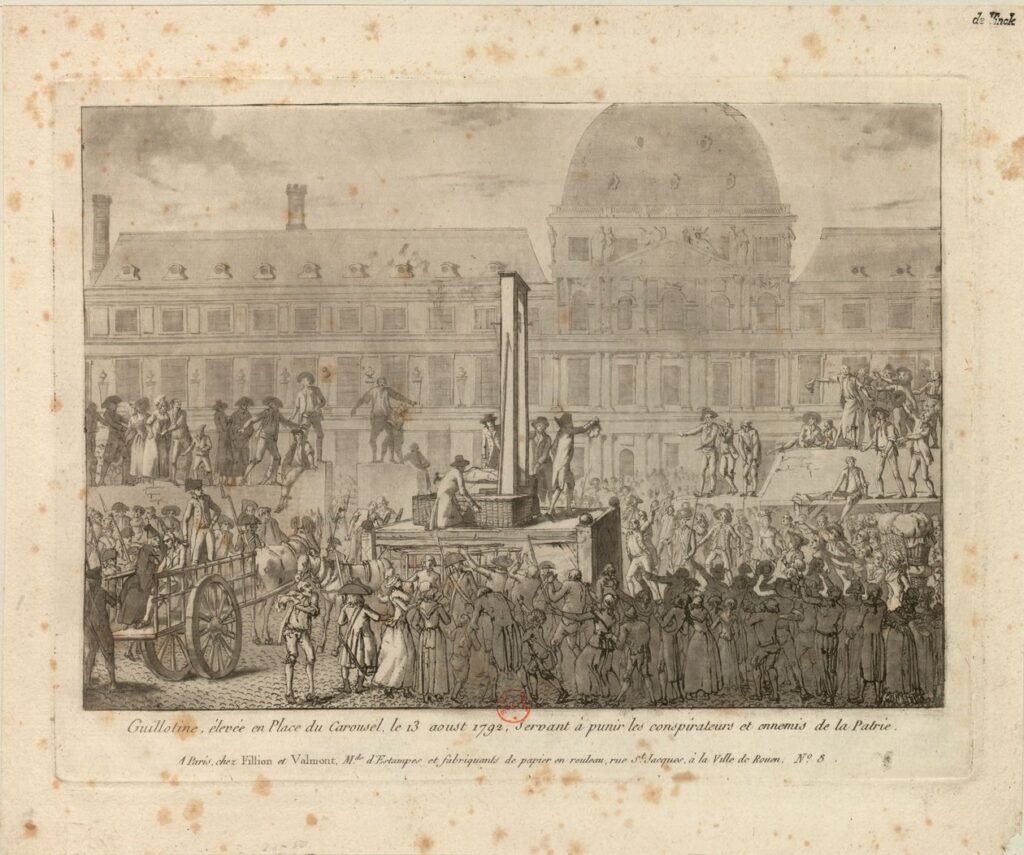
Symbol of the French Revolution
As the French Revolution progressed and violence escalated, the guillotine was used with increasing frequency. It came to symbolize the radical phase of the Revolution, particularly the Reign of Terror (1793–1794), during which thousands of people were executed for perceived disloyalty to the revolutionary cause.
High-profile victims included King Louis XVI, Queen Marie Antoinette, revolutionary leaders like Georges Danton and Maximilien Robespierre, and countless others from all social classes. The guillotine was moved to several locations across Paris, including the Place de la Révolution (now Place de la Concorde), and operated almost daily during the peak of the Terror.
The machine, originally intended as a tool for justice and equality, became associated with fear, tyranny, and state-sponsored violence. It earned nicknames like “The National Razor” and inspired both horror and dark fascination among contemporaries and future generations.
Public Reaction and Cultural Impact
Public perception of the guillotine evolved over time. Initially, many welcomed it as a progressive innovation aligned with the Revolution’s ideals. However, as the death toll mounted and the political climate grew more oppressive, the guillotine became a symbol of excess and cruelty.
Artists, writers, and philosophers of the time referenced the guillotine in their works. The image of the falling blade and severed heads haunted French society. Even after the Revolution, it remained a prominent symbol in literature and art. Its legacy influenced global debates about the death penalty and human rights.
The Guillotine After the Revolution
Despite its bloody history during the Revolution, the guillotine remained France’s standard method of execution for nearly two centuries. It was used during various regimes—Napoleonic, royalist, republican, and even Vichy France during World War II.
The last public guillotining in France occurred in 1939, and the final execution by guillotine took place in 1977. In 1981, France officially abolished the death penalty, and with it, the guillotine was retired permanently.
Conclusion
The introduction of the guillotine in Paris in 1792 was more than the deployment of a new execution device—it was the materialization of Enlightenment thought, revolutionary zeal, and the desire to reform a deeply unjust penal system. Though it ultimately became a feared emblem of state violence, its origins were grounded in ideals of equality and compassion. The story of the guillotine is a striking illustration of how technological innovation can intersect with political upheaval, leaving a lasting imprint on the course of history.














Leave a Comment
Your email address will not be published. Required fields are marked with *