
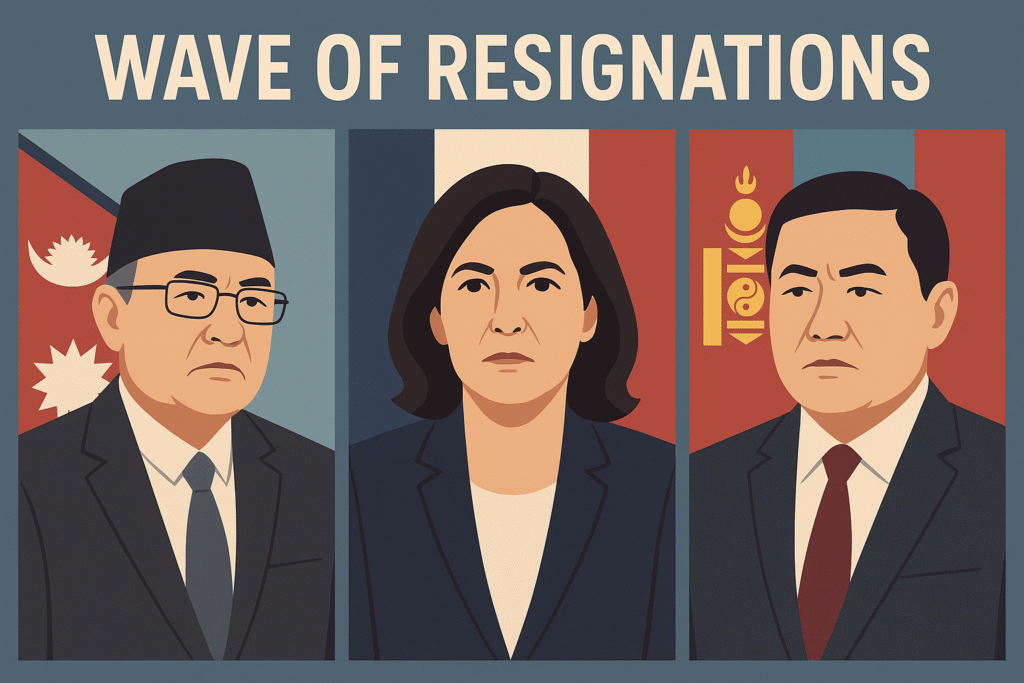
In a rare sequence of events, three prime ministers from different countries have resigned within weeks of one another, shaking political landscapes and raising questions about global stability.
The resignations, though emerging from distinct national contexts, share common threads — public anger over corruption, economic hardship, and growing demands for accountability.
Domestic Causes Behind the Exits
In Nepal, weeks of anti-corruption protests led largely by students and young citizens escalated after the government restricted major social media platforms. Demonstrators accused leaders of suppressing free speech and failing to deliver on promises of transparency. The unrest left at least 20 people dead and forced the Prime Minister to announce his resignation.
In France, mounting dissatisfaction over pension reforms and soaring living costs spiraled into mass demonstrations across Paris and other major cities. Unable to secure parliamentary support and under pressure from trade unions, the French Prime Minister tendered her resignation to the President, admitting she had “lost the public’s confidence.”
Meanwhile, in Mongolia, revelations of a multi-million-dollar coal corruption scandal triggered nationwide rallies. Protesters accused the ruling elite of siphoning off state resources while ordinary citizens struggled with rising fuel and food prices. After weeks of unrest, the Prime Minister stepped down, promising to “clear the way for reforms.”
International and Geopolitical Impact
The resignations have rattled neighboring countries and global powers alike. Diplomatic analysts warn of potential shifts in alliances and policies, especially as new leadership takes shape.
- In South Asia, Nepal’s political crisis has heightened concerns in both India and China, who compete for influence in the Himalayan nation.
- France’s sudden leadership vacuum is being closely watched across the European Union, as debates on economic recovery, immigration, and defense remain unresolved.
- Mongolia’s upheaval has drawn attention from Russia and China, key trade partners, raising questions about stability in a resource-rich but geopolitically sensitive region.
Broader Implications
Observers note that these consecutive resignations highlight a global trend of governments under siege by economic crises, social media–driven protests, and declining trust in political institutions.
“Citizens today are far less patient with corruption or incompetence,” said Dr. Anika Verma, a political analyst. “From Europe to Asia, leaders are being forced out when they fail to meet public expectations.”
For now, interim governments are in place in each of the three nations, but uncertainty looms large. How successor leaders manage the crises will not only shape domestic politics but also influence regional and international relations in the months to come.













Leave a Comment
Your email address will not be published. Required fields are marked with *